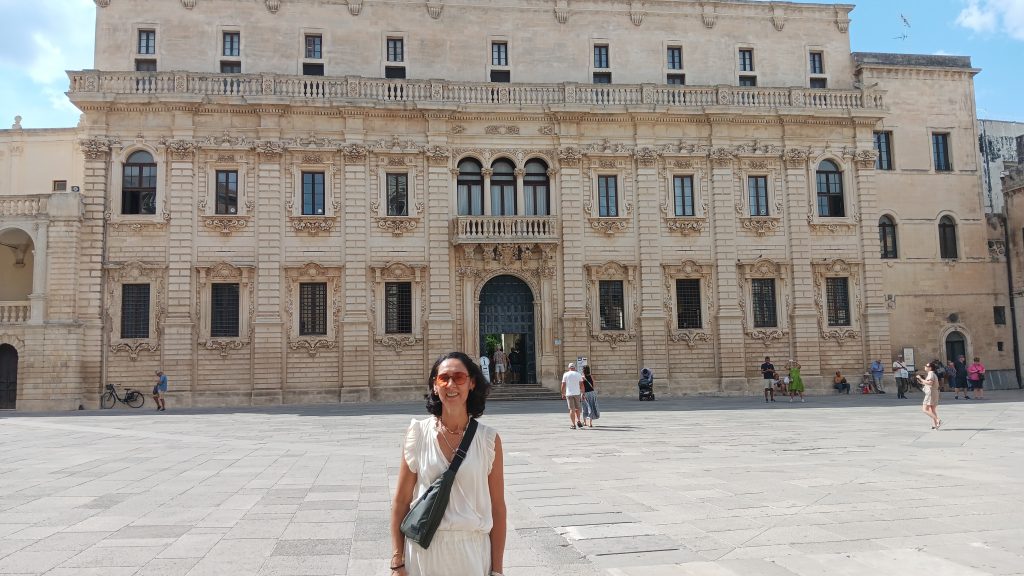
Lecce, in southern Italy’s Puglia region, often called the “City of the Sun,” has a long and layered history. According to legend, it was founded during the time of the Trojan War in the early 8th century BC by the Messapi—a mysterious people who arrived in the Salento region from the east. Ongoing archaeological excavations continue to reveal Messapian remains, followed by Greek and later Roman influences.
Today, Lecce is rich with historical landmarks: castles, amphitheaters, statues, mosaics, and grand churches are woven throughout the city.
For these reasons Lecce is a popular destination on southern Italy tours.
First Impressions
We visited Lecce this past fall. Compared to other towns we explored in Puglia, Lecce felt noticeably busier—likely because it is a university city, giving it a steady rhythm of students, cultural events, and daily life throughout the year.
The architecture also stood apart. While much of Puglia is defined by Romanesque churches and whitewashed simplicity, Lecce’s buildings display an exuberant Baroque style. Constructed from soft, honey-colored pietra leccese, churches and palaces are richly decorated with intricate carvings, scrolls, figures, and symbolic motifs. This ornate beauty is why Lecce is often called the “Florence of the South.”
Piazza Sant’Oronzo
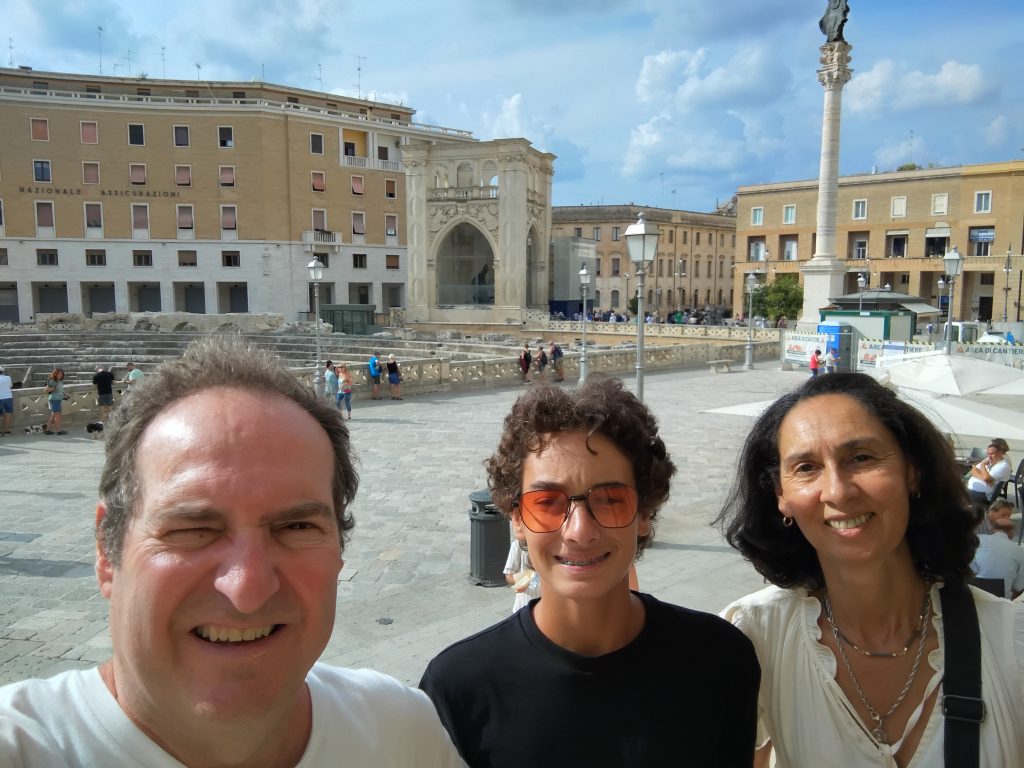
Piazza Sant’Oronzo is the heart of Lecce’s historic center. An excavated Roman amphitheater sits prominently within the square, offering a striking contrast between ancient ruins and modern life.
Several espresso cafés line the piazza, many with outdoor seating overlooking the square. For both quality and comfort, Caffè Tentazioni stands out, offering indoor and outdoor seating. Another well-known stop is Caffè Alvino.
The city’s patron saint, Sant’Oronzo, is currently undergoing restoration. His statue, normally placed atop a column nearby, can presently be viewed at street level during certain periods—a rare opportunity.
The streets leading in and out of the centro are filled with restaurants, cafés, bookstores, and shops selling local wines and foods. There is also an English-speaking pharmacy located directly on the piazza.
Lecce Centro Storico
Vehicle traffic in the centro storico is restricted to residents and service vehicles, making it a pleasure to explore on foot. Wandering through the narrow stone streets reveals beautiful architecture, local shops, and an abundance of inviting restaurants and cafés.
Lecce’s commercial history has greatly shaped what visitors see today. The city is enclosed by historic walls and includes fortresses, an imposing castle, and a network of coastal watchtowers—once used to guard both the Adriatic Sea to the east and the Ionian Sea to the west, each roughly seven miles away. Lecce’s beaches are a short drive away and are notably beautiful.
Despite the compact size of the centro storico, there are approximately 75 palazzi, most built by wealthy private residents rather than institutions. Many fortunes were made through the olive oil trade. Puglian olive oil was once a precious commodity throughout the Mediterranean, used to light lamps and for many essential purposes. Gallipoli served as the primary export port.
Today, the Puglia region is home to roughly 60 million olive trees, making Salento one of the most important olive oil-producing areas in Italy. While recent blight has affected some groves, many farms remain productive, and tours are available to learn about cultivation and production.
Lecce Environs & Baroque Highlights
Both group and private tours are widely available in multiple languages. We used a private guide who speaks English, German, and Italian and found the experience especially informative.
Lecce is also known as the “Lady of Baroque.” From the 17th century onward, civic and religious buildings were constructed in a distinctive Baroque style influenced by Spanish rule. The city’s golden limestone allowed stonecutters to create remarkably detailed, lace-like carvings.
Baroque masterpieces include Piazza del Duomo and several extraordinary churches, most notably the Basilica di Santa Croce. If you have time to visit only one church, this is the standout. Its stunning façade is richly adorned with carved animals, gargoyles, floral motifs, and an impressive rose window.
Tickets for church interiors are sold at the ticket office in Piazza del Duomo, with multi-church passes available over several days.
Parks, Gates, and Beyond
Several pleasant parks and piazzas sit just outside the centro, many with fountains and shaded seating. Built in 1548, the Triumphal Arch of Charles V, also known as Porta Napoli, honors the emperor who fortified the city.
Outside the city center lies Lecce’s historic cemetery, featuring beautifully designed mausoleums belonging to families who shaped the city’s history. Adjacent is an open-air park with preserved ruins—best visited outside peak summer heat.
Piazza Mazzini, a modern and upscale area just beyond the centro storico, features a striking contemporary fountain with dramatic lighting. This district offers insight into daily life beyond the old city and serves as Lecce’s main shopping area, complete with modern apartment buildings and a large daily outdoor market.
Lecce Main Tourist Streets
- Via Vitorio Emanuele II from Piazza Sant’Oronzo to Porta Rudiae
- Retrace your steps to Via Giuseppe
- Palmieri starts opposite Piazza del Duomo and ends at Porta Napoli.
- Recommend Caffè Paisiello on Palmieri 100 yards before Porta Napoli highly regarded by old time residents. Music inside was much too loud … maybe sit outside
- find tennis club immediately outside the porta for an unusual aspect of Lecce open to public, although not promoted to the public. Note the statue of the nude tennis player near the entrance. Food and soft drinks in the club house, with basic service at the few outdoor tables clay courts with bleachers on the side and behind the club house.
Passeggiata (Evening Walk)
Lecce’s evening passeggiata is lively and social. The main pedestrian route runs:
- Via Vittorio Emanuele II (starting at Piazza del Duomo)
- Through Piazza Sant’Oronzo
- Along Via Salvatore Trinchese
- Ending at Piazza Mazzini
This route comes alive in the early evening and is ideal for strolling and people-watching.
Recommended Restaurants in Lecce
The following restaurants are upscale – based on personal experience, not reviewed by other sources. All are walking distance from Piazza Sant’Oronzo:
Osteria degli Spiriti
Elegant interior. Intelligent, attentive, waiters. Well-prepared food with creative ingredients, and ‘old favorites’ wines from most regions in Italy, including Piedmont
Blu Notte
Fresh seafood focus selecting specific whole fish is expensive but can feed two people comfortable and well-designed interio cozy room in back.
Ristorante con Bar All’Ombra del Barocco
By-pass outdoor tables, and go inside restaurant at the end of the walkway on the side of outdoor seating area where it is comfortable, slightly modern, pleasant interior, vaulted ceilingslaid-back, tasteful, quiet jazz on music system bookcases and wines on walls. Moderately priced local food well done and good wait staff
NOTE: the bookstore beside and wine store across the street are also Liberrima entities and are worth visiting
Pescheria Con Cottura
Via dei Mocenigo, 23, 73100 Lecce LE – Seafood focus selecting specific whole fish will be expensive but can feeds two. Slightly less than luxury prices, modern interior.
La Torre di Merlino
Upscale, but slightly less than luxury price menu spans local, Mediterranean, and greater Italian cuisines. Gourmet preparations good restaurant to try unfamiliar dishes … waiter’s recommendations can be trusted; small connected rooms with vaulted ceilings – outdoor dining.
Most visitors find that 2 to 3 days is ideal for Lecce. This allows time to explore the historic centro storico, visit Baroque landmarks like Basilica di Santa Croce and Piazza del Duomo, enjoy cafés and restaurants, and still take a short trip to nearby beaches on the Adriatic or Ionian coasts.
Yes—Lecce is absolutely worth visiting, especially for travelers interested in history, architecture, and authentic southern Italian culture. Its unique Baroque style, lively university atmosphere, excellent food, and proximity to beautiful beaches make it one of Puglia’s most rewarding destinations. We love all the towns in Puglia but if you are looking for a more urban place Lecce has it.
Lecce is famous for its Lecce Baroque architecture, carved from local pietra leccese. It is often called the “Florence of the South” and is known for landmarks such as the Basilica di Santa Croce, Piazza del Duomo, Roman amphitheater, and its long tradition of stone carving and olive oil production.
Unlike many whitewashed, Romanesque towns in Puglia, Lecce stands out for its ornate Baroque buildings and busier, more urban feel. As a university city, it has a vibrant, year-round energy, with cultural events, shops, and restaurants that stay active beyond the summer tourist season
Yes, Lecce is an excellent base for exploring the Salento region. Both the Adriatic and Ionian coastlines are about 20–30 minutes away by car, and towns like Otranto, Gallipoli, and Santa Maria di Leuca are easy day trips.