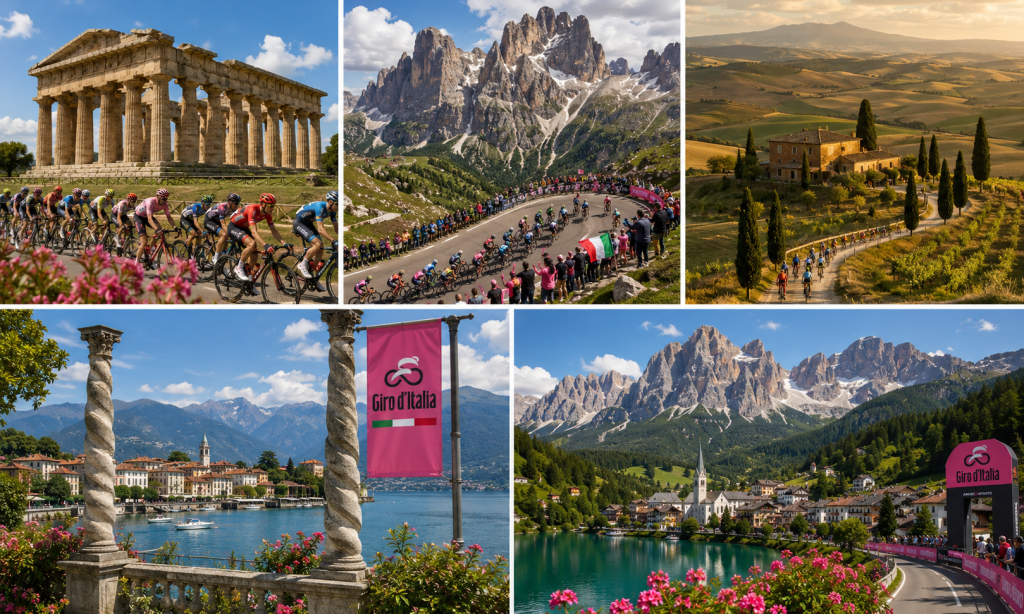
The 2026 Giro d’Italia first three stages were raced in Bulgaria. With the Bulgarian stages concluded today, the race moves to Italy beginning May 11.
The Giro D’Italia is fun to watch not only for its exiciting bike racing, but also for the lens it provides into various towns across Italy.
The 2026 Giro d’Italia offers a spectacular cross-section of Italian history, landscape, and cuisine.
This year the race begins in Southern Italy and rides north zig zagging through the Italian regions all the way to the Dolomites Alps before returning to central Italy May 31 for its conclusion in Rome.
Here are some tourism and sightseeing highlights by stages. Tune in to enjoy the race and scenary. To plan a Italy trip to these areas check out the Italy tour finder.
Stage 4 – May 12: Catanzaro to Cosenza
Regions: Calabria
- Catanzaro: Known as the “City of the Two Seas,” it features the Bisantis Bridge, one of Europe’s tallest single-arch viaducts. Nearby, the Scolacium Archaeological Park contains impressive remains of a Roman forum and a Norman abbey.
- Cosenza: The historic center, Cosenza Vecchia, is a maze of steep alleys leading to the Hohenstaufen Castle. Don’t miss the MAB (Museo all’Aperto Bilotti), an open-air museum in the modern city featuring sculptures by Dalí and De Chirico.
- Food: Sample Lagane e ceci (wide pasta with chickpeas) and the local coffee-based soda, Brasilena.
Stage 5 – May 13: Praia a Mare to Potenza
Regions: Calabria & Basilicata
- Praia a Mare: Famous for the Isola di Dino, which features sea caves like the Blue Grotto and Lion Grotto. The Sanctuary of Madonna della Grotta, built inside a natural cave, offers stunning coastal views.
- Potenza: The highest regional capital in Italy. Walk the Via Pretoria, the city’s social spine, and visit the Cathedral of San Gerardo.
- Food: Try Peperoni Cruschi—crispy, sun-dried Senise peppers that are a staple of Lucanian cuisine.
Stage 6 – May 14: Paestum to Naples (142km)
Region: Campania
Stage 6 is a true highlight of the 2026 route, bridging the gap between the ancient world and the bustling energy of modern Italy.
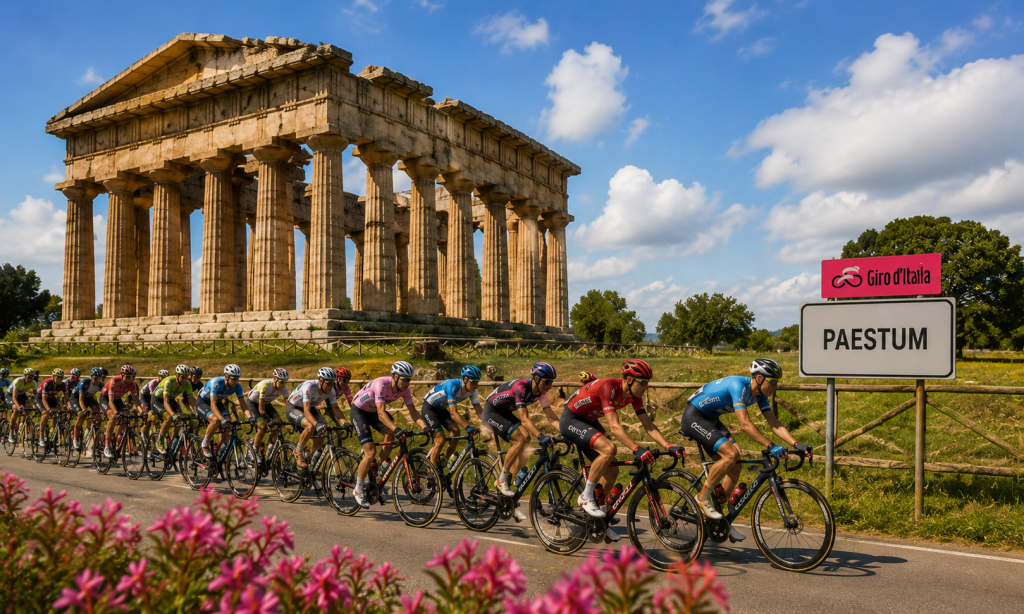
- Paestum: This is home to three of the best-preserved ancient Greek temples in the world—the Temple of Hera, the Temple of Neptune, and the Temple of Athena. Built between 550 and 450 BC, these Doric structures stand in a grassy archaeological park that is far less crowded than Pompeii. Don’t miss the Tomb of the Diver in the local museum, a rare and beautiful example of Greek funerary painting.
- The Cilento Coast: As the race moves north from Paestum, it skirts the northern edge of the Cilento and Vallo di Diano National Park, a UNESCO World Heritage site known for its rugged coastline and crystal-clear water.
- Naples (Napoli): The race finishes in one of the world’s oldest continuously inhabited cities. The historic center is a UNESCO site, filled with treasures like the Veiled Christ in the Sansevero Chapel and the underground ruins of Napoli Sotterranea. For a classic view, head to the Lungomare (waterfront) to see the Castel dell’Ovo with Mount Vesuvius looming in the distance.
Culinary Highlights:
- Buffalo Mozzarella: The area around Paestum is the heart of Mozzarella di Bufala Campana production. Many local “caseifici” (dairies) offer tours where you can see the buffalo and taste the cheese while it’s still warm.
- Pizza Napoletana: In Naples, pizza is an art form. Look for the “Vera Pizza Napoletana” seal. The secret lies in the San Marzano tomatoes grown in the volcanic soil of Vesuvius and the high-temperature wood-fired ovens that create that signature charred, airy crust.
- Street Sweets: While walking the Spaccanapoli, grab a Sfogliatella (a shell-shaped pastry with ricotta filling) or a Babà soaked in rum.
Stage 7 – May 15: Formia to Blockhaus
Regions: Lazio & Abruzzo
- Formia: Explore the Cisternone Romano, a massive 1st-century BC underground water reservoir. The town is also the legendary site of the Tomb of Cicero.
- Blockhaus: Located in the Majella National Park, this finish offers rugged, high-altitude beauty. It takes its name from a 19th-century military stone fort used to combat brigandage.
- Food: In Formia, look for Tiella di Gaeta, a savory stuffed pizza pie typically filled with octopus or escarole.
Stage 8 – May 16: Chieti to Fermo
Regions: Abruzzo & Marche
- Chieti: Visit the National Archaeological Museum of Abruzzo to see the Warrior of Capestrano, a striking 6th-century BC limestone statue.
- Fermo: Home to one of the best-preserved Roman Cisterns in the world—a 30-room underground complex. The Piazza del Popolo is a Renaissance masterpiece.
- Food: This area is famous for Vincisgrassi, a rich, multi-layered Marche-style lasagna.
Stage 9 – May 17: Cervia to Corno alle Scale
Region: Emilia Romagna
- Cervia: Known as the “City of Salt,” you can visit the MUSA Salt Museum or the ancient salt pans where flamingos often gather.
- Corno alle Scale: A peak in the Tuscan-Emilian Apennines where the view on clear days stretches from the Alps to the Adriatic.
- Food: Enjoy Piadina Romagnola in Cervia and dishes featuring local chestnut flour or mountain blueberries near the finish.
Stage 10 – May 19: Viareggio to Massa (42km ITT)
Region: Tuscany
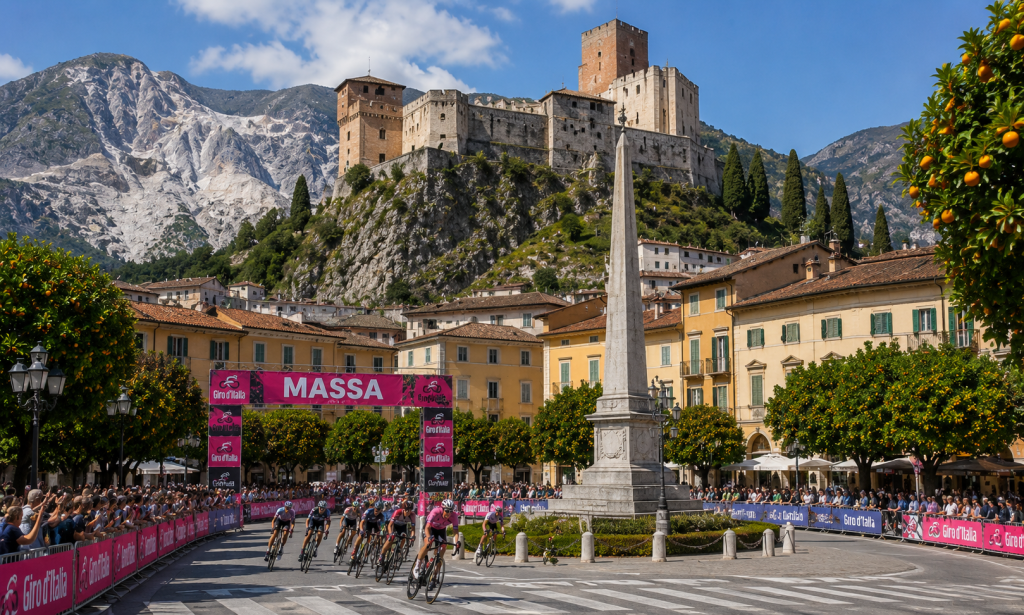
Stage 10 is a unique and high-stakes day in the race, taking place entirely within the beautiful region of Tuscany. As a 42km Individual Time Trial (ITT), it offers a slower-paced viewing experience for fans as riders depart one by one.
- Viareggio: Known as the “Pearl of the Tyrrhenian Sea,” this city is famous for its Liberty-style (Italian Art Nouveau) architecture. Take a stroll along the Passeggiata di Viareggio, a long promenade lined with elegant boutiques, cafes, and historic bathhouses. It is also the home of Italy’s most famous Carnival, celebrated with massive, intricate papier-mâché floats.
- The Versilia Coast: The route hugs the coastline of Versilia, an area renowned for its wide sandy beaches and high-end seaside resorts like Forte dei Marmi. On one side, you have the sparkling sea, and on the other, the dramatic, jagged peaks of the Apuan Alps.
- The Marble Mountains: As the race approaches Massa, you will see the white patches on the mountainsides. These aren’t snow—they are the world-famous Carrara Marble Quarries. This is the same stone Michelangelo used to carve his David. You can take specialized 4×4 tours deep into the quarries to see how the “white gold” is extracted.
- Massa: The finish line is set against a city dominated by the Malaspina Castle, a massive fortress and Renaissance palace that overlooks the city from a rocky outcrop. The central Piazza degli Aranci, surrounded by orange trees and featuring a central obelisk, is the perfect spot to soak in the atmosphere.
Culinary Highlights:
- Lardo di Colonnata: A must-try from this specific corner of Tuscany. It is pork back fat cured in local marble basins with rosemary and spices. It’s best served sliced paper-thin on warm, toasted bread.
- Cecina: A savory, thin pancake made from chickpea flour, water, olive oil, and salt. It’s a popular coastal street food—crispy on the outside and soft on the inside.
- Tuscan Seafood: Unlike the heavy meat dishes of inland Tuscany, the coast focuses on fresh catches. Look for Spaghetti allo Scoglio (shellfish pasta) or Cacciucco (a rich fish stew, though most famous in nearby Livorno).
- Vermentino: The hills behind Massa and Carrara produce excellent, crisp Vermentino white wines that pair perfectly with the local seafood and salty lardo.
Stage 11 – May 20: Porcari to Chiavari
Regions: Tuscany & Liguria
- Cinque Terre: This stage passes through this world-famous coastal stretch. While the race moves fast, the views of the colorful cliffside villages are unparalleled.
- Chiavari: A refined town with medieval arcades (portici) and the Palazzo Rocca. It’s also famous for the lightweight Campanino chairs.
- Food: Classic Ligurian Pesto Genovese and Focaccia di Recco (filled with melted cheese).
Stage 12 – May 21: Imperia to Novi Ligure
Regions: Liguria & Piedmont
- Imperia: Visit the Villa Grock, the whimsical home of the “King of Clowns,” Adrien Wettach, which features surrealist architecture and gardens.
- Novi Ligure: A pilgrimage site for cycling fans, home to the Museo dei Campionissimi, dedicated to legends Fausto Coppi and Costante Girardengo.
- Food: This is chocolate country—home to major producers like Pernigotti and Novi.
Stage 13 – May 22: Alessandria to Verbania
Region: Piedmont
- Verbania: Situated on Lake Maggiore, the highlight is the Villa Taranto Botanical Gardens, featuring over 20,000 plant varieties.
- Food: Try Margheritine di Stresa, delicate cookies originally created for Queen Margherita of Savoy.
Stage 14 – May 23: Aosta to Pila
Region: Aosta Valley
- Aosta: Known as the “Rome of the Alps” due to its remarkably preserved Roman walls, the Arch of Augustus, and a Roman theater.
- Pila: Accessible by a panoramic cable car from Aosta, offering 360-degree views of Mont Blanc, the Matterhorn, and Monte Rosa.
- Food: Fontina cheese and Carbonada (beef stewed in red wine).
Stage 15 – May 24: Voghera to Milano
Region: Lombardy
- Milan: The race concludes in Italy’s fashion capital. Highlights include the Duomo, the Galleria Vittorio Emanuele II, and Leonardo da Vinci’s The Last Supper.
- Food: Risotto alla Milanese (saffron risotto) and Cotoletta alla Milanese.
Stage 16 – May 26: Bellinzona to Carì (113km)
Region: Ticino (Switzerland)
Stage 16 takes the Giro out of Italy and into the stunning Italian-speaking Canton of Ticino in Switzerland. This “mini-stage” is short at only 113km, but it is packed with vertical gain and incredible Alpine scenery.
Following the race into Switzerland adds a completely different aesthetic to the trip—sharp Alpine peaks, pristine Swiss organization, and a fascinating blend of Italian culture with Swiss precision.
- Bellinzona: This city is famous for its three medieval castles: Castelgrande, Montebello, and Sasso Corbaro. Together with their defensive walls, they form a UNESCO World Heritage site that is one of the most important examples of medieval defensive architecture in the Alps. The castles look like something out of a fairytale, perched on rocky peaks overlooking the Ticino Valley.
- The Leventina Valley: The race travels through this narrow, dramatic valley, which has been a vital trade route through the Alps for centuries. The route features a “cloverleaf” style loop, meaning spectators in the valley can see the riders pass multiple times before they tackle the final ascent.
- Carì: The finish is a demanding climb to this sunny mountain terrace at 1,650 meters. Originally a small farming settlement, it is now a peaceful ski and hiking resort. The views from the top across the Leventina and towards the surrounding 3,000-meter peaks are breathtaking.
Culinary Highlights:
- Polenta Rosso del Ticino: A staple of the region, this polenta is made from a local red corn variety. It’s often served in a traditional “Grotto”—a rustic, cave-like restaurant—accompanied by hearty stews or local mountain cheeses.
- Ticino Merlot: This region is world-renowned for its Merlot. Unlike the heavy versions found elsewhere, Ticino Merlot is often elegant and can even be found as a “white” wine (Merlot Bianco).
- Zincarlin: A unique, bell-shaped raw milk cheese from the nearby Muggio Valley. It’s treated with white wine and salt daily during its two-month aging process, giving it an intense, spicy flavor.
- Chestnut Specialties: Chestnuts were once the “bread of the poor” in Ticino. Today, they are a delicacy used in everything from Chestnut Cake (Torta di Castagne) to honey and even beer.
Stage 17 – May 27: Cassano d’Adda to Andalo (202km)
Regions: Lombardy & Trentino-Alto Adige
Stage 17 marks the return of the Giro to Italian soil, crossing from the plains of Lombardy into the jagged, breathtaking peaks of the Trentino region. This is a classic transitional stage that moves from river valleys to high-altitude mountain air.
This stage is a favorite for travelers who love the transition from the elegant villas of Lombardy to the rustic, wood-shingled charm of the Dolomite villages.
- Cassano d’Adda: Located on the border between Milan and Bergamo, this town is home to the majestic Castello Visconteo, a 13th-century fortress that once hosted Leonardo da Vinci. It sits along the Adda River, where you can explore the Ecomuseum of Leonardo, which features the historic ferry he designed.
- Lake Garda (Western Shore): As the race moves northeast, it skirts the northern reaches of Lake Garda. The scenery shifts from industrial plains to Mediterranean-like landscapes with lemon groves and olive trees set against the backdrop of rising mountains.
- The Brenta Dolomites: The stage finish in Andalo is nestled on a high plateau between the Paganella Massif and the spectacular Brenta Dolomites. Unlike the “Pale Mountains” of the East, the Brenta Dolomites are known for their sharp, red-tinged limestone spires and towers, providing some of the most dramatic photography in the Alps.
- Andalo and Lake Molveno: Just a few minutes from the finish line is Lake Molveno, frequently voted the most beautiful lake in Italy. Its crystal-clear turquoise water perfectly reflects the surrounding Dolomite peaks.
Culinary Highlights:
- Trentingrana: A premium hard cheese produced in the mountain dairies of Trentino. It is similar to Parmigiano but has a distinct floral flavor due to the high-altitude pastures where the cows graze.
- Carne Salada: A local specialty of thinly sliced, salt-cured beef. It is often served raw as carpaccio with a drizzle of local extra virgin olive oil from the Lake Garda region, or lightly seared and served with “fasoi” (beans).
- Strudel di Mele: You are now in Italy’s apple capital. The Val di Non (which the race passes near) is famous for its Melinda apples, and a warm apple strudel with pine nuts and raisins is the quintessential dessert of this region.
- Teroldego Rotaliano: Often called the “Prince of Trentino wines,” this deep, ruby-red wine is grown in the Rotaliano plain at the foot of the mountains. It is bold, fruity, and the perfect pairing for a hearty mountain meal.
Stage 18 – May 28: Fai della Paganella to Pieve di Soligo (171km)
Regions: Trentino Alto Adige & Veneto
Stage 18 is a breathtaking journey that transitions from the high Alpine plateaus of Trentino into the rolling, vine-covered hills of the Veneto. It is a stage of dramatic contrasts, moving from jagged mountain peaks to the elegant landscapes that produce Italy’s most famous sparkling wine.
This stage is perfect for those who enjoy “Slow Tourism”—combining the excitement of the race with vineyard tours, boutique villa stays, and some of the finest sparkling wine tastings in the world.
- Fai della Paganella: Perched on a natural balcony, this start location offers one of the most famous panoramas in the region, looking out over the Adige Valley. It’s a gateway to the Paganella Ski area, known for its lush summer meadows and dense pine forests.
- The Prosecco Hills (UNESCO World Heritage Site): As the race enters the province of Treviso, it winds through the Colline del Prosecco di Conegliano e Valdobbiadene. This landscape is characterized by “ciglioni”—small plots of vines on narrow grassy terraces. The embroidery-like hills are dotted with ancient chapels and tiny villages.
- Pieve di Soligo: Located in the heart of the “Quarter del Piave,” this town is an architectural gem. Highlights include the Villa Brandolini, which hosts prestigious art exhibitions and musical events, and the serene banks of the Soligo River. The town has a refined, quiet elegance typical of the Venetian inland.
- Muro di Ca’ del Poggio: The race often features this legendary climb nearby. It is a steep “wall” surrounded by vineyards, where it is tradition for fans to watch the riders pass while enjoying a glass of Prosecco and local appetizers at the top.
Culinary Highlights:
- Prosecco Superiore DOCG: This is the spiritual home of Italy’s famous sparkling wine. Unlike mass-produced versions, the Prosecco from the hills of Pieve di Soligo and Valdobbiadene is sophisticated, crisp, and carries the “Superiore” designation.
- Radicchio Rosso di Treviso: If you are dining in the area, look for the late-season IGP Radicchio. It is often grilled, tossed in risotto, or even prepared as a jam. Its pleasant bitterness is a staple of Veneto cuisine.
- Sopressa Vicentina: A large, aged salami that is soft and flavored with garlic and pepper. It is traditionally served with slices of grilled Polenta Bianca (white polenta), which is more common in this part of the Veneto than the yellow variety.
- Tiramisù: The city of Treviso, just to the south, is the birthplace of this iconic dessert. In Pieve di Soligo, you will find versions made with the freshest local mascarpone and savoiardi biscuits.
Stage 19 – May 29: Feltre to Alleghe
Regions: Veneto
- Feltre: A stunning “painted city” (Urbs Picta) with frescoed Renaissance palaces.
- Alleghe: A village on the banks of a turquoise lake at the foot of the Civetta massif in the Dolomites.
- Food: Casunziei (half-moon pasta filled with beet or pumpkin).
Stage 20 – May 30: Gemona del Friuli to Piancavallo (200km)
Regions: Friuli-Venezia Giulia
Stage 20 is the final competitive mountain showdown of the 2026 Giro, and it carries a deep emotional weight for the region of Friuli-Venezia Giulia. It is both a grueling athletic test and a powerful tribute to resilience.
This stage offers a profound look at the “real” Italy—far from the main tourist tracks—where the bond between the people, the mountains, and their history is incredibly strong.
- Gemona del Friuli (1976–2026): This start is a solemn commemoration of the 50th anniversary of the devastating 1976 earthquake. Gemona is known as a symbol of “Friulian Tenacity” because it was meticulously rebuilt stone by stone. The Duomo di Santa Maria Assunta is a must-see; its slightly leaning facade was preserved as a reminder of the quake, while the interior was beautifully restored.
- The Alpe Adria Cycle Path: The race passes through areas connected by this world-famous cycling route. If you have time, the section near Gemona includes spectacular tunnels and bridges repurposed from an old Austro-Hungarian railway line, offering some of the best gravel and road cycling in Europe.
- Venzone: Just north of the route, this medieval walled town was named “Italy’s Most Beautiful Village” in 2017. It is famous for its lavender-colored buildings and the “Mummies of Venzone”—naturally preserved bodies found in the Cathedral’s crypt.
- Piancavallo: The finish line sits at a high-altitude resort overlooking the Venetian-Friulian plain. On a clear day from the top, you can see all the way to the Adriatic Sea and the lagoons of Venice. It’s a natural balcony of the Friulian Dolomites.
Culinary Highlights:
- Pan di Sorc: A traditional “sweet-and-savory” bread from Gemona made from a blend of corn, rye, and wheat flour, flavored with elderberry, cinnamon, and raisins. It is a Slow Food Presidium product and a true taste of local history.
- Formaggio di Latteria: Friuli is famous for its communal dairies (latterie turnarie). Try the local Montasio-style cheeses, which range from fresh and milky to aged and spicy.
- San Daniele Prosciutto: The race passes very near San Daniele del Friuli. This is the perfect place to stop for a platter of the world’s most delicate, melt-in-your-mouth prosciutto, which is cured only by the unique microclimate where the mountain air meets the Adriatic breeze.
- Gubana: For dessert, look for this snail-shaped pastry filled with a rich mixture of nuts, raisins, chocolate, and grappa. It is the signature celebratory cake of the region.
Stage 21 – May 31: Rome to Rome
Region: Lazio
- The Finish: The final circuit passes the Colosseum, the Roman Forum, and the Baths of Caracalla, finishing on the Via del Circo Massimo.
- Food: Celebrate the end of the Giro with a classic Pasta alla Carbonara or Carciofi alla Giudia (Jewish-style fried artichokes).

Travel specialist and Italy tour expert featured in major international publications. Expert insights, media coverage, and curated Italy travel experiences.
Leave a Reply