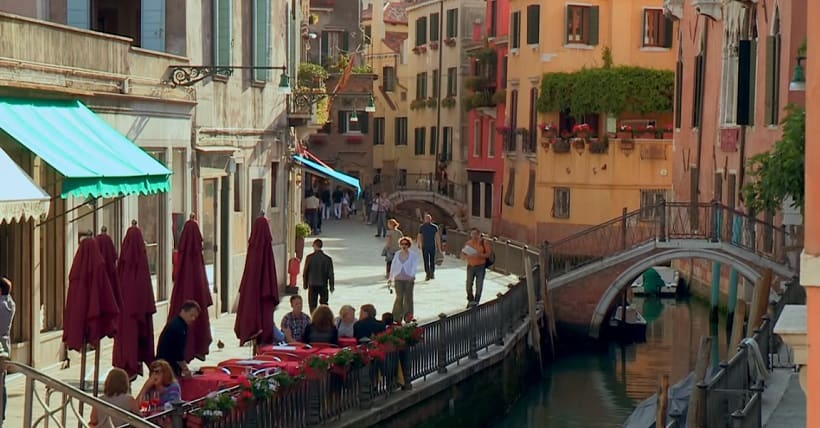
The Venice travel guide provides Venice sightseeing information. Venice is one of Italy’s most popular tourist attractions. It is also one of Italy’s largest cities. If your Venice sightseeing plans include one day or a few days, you’ll find this Venice travel guide helpful. The guide includes Venice sightseeing walking map, Venice hotels, Venice restaurants, Venice day trips, and escorted Italy tours that include Venice.
Venice is also a popular embarkation and disembarkation port for Adriatic and Mediterranean cruises around Italy. For more information click through to the Venice cruises webpage.
Venice Location and History
Venice is located in northeast Italy at the top of the Adriatic Sea in northern Italy’s Veneto region. It is a collection of 118 tiny islands located in the lagoon. The islands are connected by over 160 bridges.
Venice was a sovereign state for over 1000 years between the 7th century and the 18th century from 697 AD until 1797 AD. Venice was a major maritime power of medieval Italy.
Venice ruled for centuries over one of the largest and richest maritime republics and trade empires in the world. Due to this rich cultural legacy and a unique identity, the regional statute describes Venetians as a “people”. You’ll discover the Venetians on your trip to Venice.
Its fabulous palaces rising from its idyllic canals are a testament to its history, power, wealth, and ingenious people.
Venice Hotels
From Venice Marco Polo airport, Venice Santa Lucia train station, or Piazzale Roma you will need to transfer to your Venice hotel. The Venice map below provides Venice hotels we suggest.
Venice Sightseeing: Getting Around Venice
To visit the Venice sightseeing attractions first you need to know how to get around Venice. The following are the Venice transportation hubs where you will arrive in Venice and depart from Venice:
 Piazzale Roma when traveling to Venice by car or bus;
 Santa Maria Lucia when traveling to Venice by train; and
- Marco Polo airport when traveling to Venice by air.
 Venice Cruise Port Terminal when traveling to Venice by cruise ship.
 Piazzale Roma when traveling to Venice by car or bus;
 Santa Maria Lucia when traveling to Venice by train; and
 Marco Polo airport when traveling to Venice by air.
 Venice Cruise Port Terminal when traveling to Venice by cruise ship.
Venice Airport and Train Station Transfers
The least expensive private or shared water taxi transfer service between Venice airport, Piazzale Roma and Venice Santa Lucia train station and the Venice Islands is via Venice’s official transfer service VeniceLink.
Venice airport transfer by Alilaguna
Alilaguna is a private ferry company that runs 3 lines of water shuttles from Venice Marco Polo airport to the floating part of Venice. They have several stops around the islands to let more people get on board. They use a color system to name their lines. For the line maps visit the Alilaguna website.
Getting Around Venice Islands
When entering Venice from the mainland by bus, car, or taxi you will end up in Piazzale Roma. When entering by train you will arrive at Santa Lucia. From both of these points, Piazzale Roma and Santa Lucia train station, you will set off to explore Venice by foot, vaporetto, or water taxi.
Foot
Venice is unquestionably a fantastic walking town. You may stroll around the alleys marveling the beautiful architecture. You will find little bars serving local wines and finger food. The streets are well marked so that you’ll find your way using a map. You can walk for hours, days, or years and always find something new as you get lost navigating the alleys. Once away from the throngs of people in Venice’s back alleys you’ll hear birds singing and Venetians living.
Vaporetto
ACTV is the City owned company that runs land and water buses in Venice. Water buses serve the 6 floating historic districts of Venice plus the Lido beach, Murano and Burano islands. ACTV water buses are nicknamed Vaporetti or singular Vaporetto. Vaporetti are an affordable way to travel around Venice.
The ACTV vaporetto card covers an amount fo time. So you may buy a card to cover one day, two days, three days etc. Then you have unlimited rides. Tickets may be purchased at the water bus major stops or inside the water bus paying an extra charge. Always validate ticket once on the vaporetto. Click here to download Vaporetto line map.

The vaporetto stops are noted by the yellow ACTV signs. The stops are easy to recognize by their yellow-and-white floating platforms.
The vaporetto #1 travels the Grand Canal to Piazza San Marco or to Piazzale Roma depending on your direction. This makes for a nice inexpensive Grand Canal sightseeing ride. It takes 40 minutes to travel between Piazzale Roma and St. Mark’s Square.
Traghetto
Black boat that looks just like the gondola. These bring people across the Grand Canal from point to point for a few euros. The ride lasts about two minutes. There are no seats so you’ll have to stand during the crossing.
Water Taxi
Water taxi ride are classy brown wooden boats that travel anywhere you choose. This is a convenient way to travel and also expensive.
Venice Sightseeing Walking Map
After settling into your Venice hotel get out and enjoy the beauty that awaits you while sightseeing in Venice.
Venice Sightseeing Tours
Top Ten Venice Sightseeing Attractions
- Use the Vaporetto #1 boat to ride up and down the Grand Canal. It is equivalent of city tour.
- Best time to visit Piazza St Marco is early in the morning or late at night.
- Private tour of St. Mark’s Basilica.
- Tour the Doge’s Palace, its priceless art and Bridge Of Sighs.
- Go to top of St. Mark’s belltower for awesome view.
- Rialto Bridge – use Vaporetto #1 to see it from water and go shopping around the area.
- Take a gondola ride through the Venice canals.
- Go to Murano to see the glass blowing artists.
- Artisan shops: masks and other classic Venetian arts are fun to see and shop.
- Teatro La Fenice dated to 1789 try to see a show.
Guided Venice day tours include the famous gondola ride, visiting the drawing room of Europe St Mark’s Square, touring the Doge’s Palace and riding the boats to the islands of Murano for glass, Burano for lace, and Torricello for your soul.
St. Mark’s Square
St. Mark’s Square is the center of Venice. St. Mark’s Basilica is one of the most beautiful in all of Europe, named after St. Mark. Two merchants from Venice stole the body from Alexandria Egypt and brought it to Venice where he now lies in the Basilica. Throughout its long history, Piazza San Marco has witnessed pageants, processions, political activities, executions, and countless Carnival festivities. Visitors flock here in the thousands for two of the city’s most important historic sites, the Basilica and the Palazzo Ducale, The Doge’s Palace. These magnificent buildings complement the lesser-known but equally valuable Campanile, Museo Correr, and Torre dell’Orologio, gardens of the Giardinetti Reali, open-air orchestras, shops, and elegant cafes, notably Quadri and Florian.
Basilica di San Marco
Venice’s most famous Basilica blends the architectural and decorative styles of East and West to create one of the greatest buildings in Europe. The exterior owes its Oriental splendor to countless treasures from the Venice republic’s overseas empire. The famous bronze horses taken from Constantinople in 1204, and a wealth of columns, bas-reliefs, and colored marbles studding the main facade. Mosaics from different epochs adorn the five doorways, while some of Italy’s loveliest Romanesque carvings frame the main doorway.
Palazzo Ducale
Scuola Grande di San Rocco
Founded in honor of San Rocco, a saint who dedicated his life to helping the sick, the Scuola started out as a charitable confraternity. Construction began in 1515 under Bartolomeo Bon and was continued by Scarpagnino until his death in 1549. The work was financed by donations from Venetians keen to invoke San Rocco’s protection and the Scuola quickly became one of the wealthiest in Venice. In 1564, its members decided to commission Tintoretto to decorate its walls and ceilings. His earliest paintings, the first of over 50 works, he eventually left in the Scuola, filling the small Sala dell’Albergo off the Upper Hall. His later paintings occupy the Ground Floor Hall, immediately within the entrance.
Santa Maria Gloriosa dei Frari
Franciscan church more commonly known as the Frari (a corruption of ‘frati,’ meaning friars). The Gothic church dwarfs the eastern area of San Polo. The first church on the site was built by Franciscan friars in 1250 to 1338 CE, but was replaced by a larger building completed in the middle of the 15th century. The airy interior is striking both for its sheer size and the quality of its artwork, including masterpieces by Titian and Giovanni Bellini, a statue by Donatello, and several grandiose tombs. The Pesaro Madonna, better known as the Madonna di Ca’ Pesaro, is a painting by the Italian Renaissance master Titian, commissioned by Jacopo Pesaro, whose family acquired in 1518 the chapel in the Frari Basilica in Venice for which the work was painted, and where it remains today. This is one of the most important pieces of art in Italy. It is another stunning Renaissance painting in Italy. This huge painting is over 16 foot high. Pesaro was the leader of the Papal Navy. He won a battle against the Turks thus it was seen as a Christian victory over Islam. In the painting St George is giving thanks. This would be a very Western viewpoint showing the victory of good over evil. St Francis and St Peter are also depicted. Click the video below for more about the art history related to this painting.
Santa Maria della Salute
The great Baroque church of Santa Maria della Salute, standing at the entrance of the Gran Canal, is one of the most imposing architectural landmarks of Venice. Henry James reputedly likened it to ‘some great lady on the threshold of her salon’. The church was built in thanksgiving for the city’s deliverance from the plague epidemic of 1630, hence the name ‘Salute’ which means health and salvation. Each November, in celebration, worshippers light candles and approach across a bridge of boats spanning the mouth of the Gran Canal for the occasion.
Rialto Bridge
The Rialto Bridge spans the Grand Canal. From the bridge there is a unique view of all the activity on the Grand Canal. The Grand Canal is where the wealthiest built their palaces in Medieval and Renaissance Venice.
Murano
Like the city of Venice, Murano comprises a cluster of small islands, connected by bridges. It is like a mini-Venice. It has been the center of the glass making industry since 1291, when the furnaces and craftsmen were moved here from the city because of the risk of fire and the disagreeable effects of smoke. Some houses on the water date from this period. Murano glass became popular in Europe in the 16th century. This is when the aritsans started created works of art rather than utilitarian pieces. The artisans turned artists guard their trade secrets. Today you can watch glass making by these incredible artists. Today knock offs from China and Taiwan market themselves as Murano glass. Always look for the trademark brand on the work of art to confirm it is an authentic piece created by an artist on Murano.
Burano
Burano is the most colorful of the lagoon islands and can be distinguished from a distance by the tilting tower of its church. In contrast with the haunting Torricello, the island is densely populated, its waterways fringed with brightly painted houses, such as the Casa Pepi. The main thoroughfare is Via Baldassare Galuppi, named after the Burano-born composer. It features traditional lace and linen stalls and open-air trattoria serving fresh fish. There is also a museum there featuring the lace making.
The colorful houses on Burano were painted so that the island’s fishermen, which was the main trade, could spot their house when returning. And while the men were fishing the ladies made lace. Today bed linen and lingerie are among the favorite linens. Burano is a nice glimpse of a slower paced life versus bustling Venice.
Venice Gondola
The Venice Gondola ride is a dream of lovers from around the world. The Gondola ride is a splendid addition to the time spent in the most romantic city in the world.
The Venice tour reviews are in! The Venice Gondola ride is a hit!! The voice, the accordion, the canals, the water, the gondola… It is one of the highlights of a Venice vacation. Here’s what you can expect on your Venice gondola ride with music.
The Gondola’s History
The Gondola is the star of Venice. It takes months to build one and is built to exact specifications. The gondola is a traditional, flat-bottomed Venetian rowing boat, well suited to the conditions of the Venetian lagoon. For centuries gondolas were the chief means of transportation. They were the most common watercraft within Venice. Gondolas were once painted in bright colors but in the 16th century a city regulation stated Gondola must be painted in black.
In modern times the iconic boats still have a role in public transport in the city. They serve as as traghetti (ferries) over the Grand Canal. For a traveler looking for a nice view and quick Gondola ride the Grand Canal crossing on a traghetti is affordable and fun. They are also used in special regattas (rowing races) held amongst gondoliers. The gondola is propelled by an oar.
Their primary role today, however, is to carry tourists on rides at fixed price of about $65 per person per Venice Gondola ride. Venice Gondola can enter canals to show off Venice’s charm from the water.
Only local Venetians may be Venice gondoliers. Joining the guild is not easy. The first woman was admitted to the guild in 2009.
Venice Restaurants
A Venice dining tradition is to visit bacari, which are bars, to enjoy cicchetti, which is finger food typically enjoyed with a glass of local wine from the Veneto region. Hop to multiple bacari in a sort of cichetti crawl to try various wines and foods. This is an inexpensive way to eat your way through Venice.
- Antico Pignolo, San Marco, Venice. Dine on pitch-perfect renditions of classic Venetian cuisine served in a 13th-century spice shop; when the weather’s warm, nab a table in the garden.
- Al Covo
- Alle Testiere, Castello, Venice. The food is as sophisticated as the atmosphere is informal at this tiny, five-table trattoria.
- Antica Ruga Rialto
- Bancogiro, Santa Croce, Venice. This osteria with contemporary flair takes full advantage of its location next to the Rialto market.
- Bottega ai Promessi Sposi – Romantic favorite for couples.
- Birraria la Corte
- Trattoria Ca’ d’Oro, Cannaregio, Venice. Settle at one of the long tables for a meal of Venetian specialties and hearty pastas.
- Cantina Do Mori, San Polo, Venice. Workers from the Rialto market have been refueling at this bacaro for more than 500 years.
- Cantinone, Dorsoduro, Venice. You won’t find cicheti here; the specialty is panini — sandwiches made with top-quality meat and cheese.
- Enoteca la Mascareta, Castello, Venice. This bacaro is a favorite evening haunt for locals.
- Il Muro San Stae
- Impronta Café – Romantic favorite for couples.
- La Zucca – Romantic favorite for couples.
- Osteria Mocenigo
- Osteria Enoteca Ai Artisti – Romantic favorite for couples.
- Osteria da Fiore, San Polo, Venice. A gastronomic temple that bloomed in the city’s back streets, Da Fiore tops the list of Venice’s fine fish restaurants.
- Osteria Da Riobo- Try to get outside table
- Ristorante Quadri – table by the window facing St. Marks
- Venissa
- Vini da Gigi – Romantic favorite for couples.
- Trattoria Al Gatto Nero – loved by locals famous for risotto located on Burano island.
Venice Festivals
Venice Carnevale
Venice’s Carnevale is the most famous and one of the oldest in Europe. It started around the year 1000 when the public began a celebration with masks. The masks provide social leveling for nobles and peasants alike rubbing shoulders hidden behind masks. Additionally, wearing a mask created a freedom for the person behind the mask.
In the early years Venice Carnevale included parades, banquets and all night dancing. Carnevale was an effort to promote freedom and play. In the early years Venice Carnevale festivities went on for 6 months. In a way Venice resembled modern day Las Vegas with entertainment and even loss of morals by visitors and inhabitants.
The elegant Carnevale started after the 16th Century and ran until Napoleon and subsequently the Austrians banned Carnevale. Carnevale began again in the 1960s. The word refers to the time leading up to the beginning of lent, and may be derived from “carne levare“, which means to remove meat.
In the 17th Century, Giacomo Casanova created his own Carnevale legend, which was love of woman. He celebrated year round embracing all manner of disguise. As the legend goes, no woman could deny his charm.
Today elements of the local culture are mixed into Carenvale around the world. Rio di Janiero has its famous party. New Orleans in the United States is known for its Mardi Gras. And Venice is known for its masks and masquerade balls. Venice is more relaxed than Rio and New Orleans. It runs for 10 days before lent and is notably upscale with high priced parties. You may also wander the canals with a one of a kind ambiance.
The most revered events is the opening of Carnevale in St Mark’s Square. The Festival of the Maria’s tells the story of 12 ladies kidnapped by pirates. The Flight of the Angel is the highlight when the angel flies down from the bell tower to the Doge, which marks the beginning of the festival. In the middle of the square is the grand theater where there are daily masked parades and entertainment.
The Carnevale Grand Ball is located in 16th Century Palace along the Grand Canal. There you’ll journey to a land of dreams in an atmosphere of royalty. This is an event where all the attendees participate not watch. Upstairs the Gala Dinner is extravagant. During dinner music and entertainers enhance the masquerade party. After dinner the DJ plays music for a full night of dancing and partying to sunrise.
Hotel Luna Baglioni Masquerade Ball
Held in the Marco Polo ballroom, guests learn to dance the Minuet. Known for its distinctive pose like gestures. During a six course meal spread through the night with unlimited prosecco, the 17th century inspired ball is a night of fun and revelry.
Carnevale Masks
Carne Sole is one of the largest mask shops. There is a huge selection of masks. The plague doctor mask with the huge nose beak is very popular, which was used by doctors. They stuffed the beak with herbs to keep out the plague. Another popular mask is the Comedia. Often made out of leather. Then there is the Casanova mask, which was traditionally used to go meet secret lovers. Authentic masks are made from paper machete and are painted. They require enormous work and typically cost between $50 and $400.
The mask allowed people to hide while simultaneously be more themselves. People can take on an identity behind the mask which is the allure.
Carnevale Costumes
Tragi Commica is one of the largest costume shops in Venice. Arrangements to rent or buy are typically made six months before Carnevale. Here every woman’s fantasy may be met with a beautiful costume. They are not cheap but certainly they are well made and gorgeous.
Venice Regata Storica
The Venice Regata Storica, the historic regatta, occurs annually on the first Sunday in September. It is a tribute to Venice’s maritime history. The main program is a parade down the Grand Canal formed by traditional colourful boats, some of which are used only in these particular events, with people in costume who interpret the upper echelon of the Venice Judiciary – the Doge and the Duchess – is a faithful reconstruction of the royal reception given to Catherine Cornaro, Queen of Cyprus, on her arrival in Venice in 1489, after her abdication in favour of the Republic.
After the parade , Venice’s rowing tradition is on full display. Venetian rowing is a discipline unique to Venice and its lagoon. It is a special technique of rowing practices in the lagoon of Venice and the surrounding areas because of the peculiarities of the environment, which requires vessels that can be easily maneuvered and a stroke that allows one to easily monitor the seabed to avoid the numerous shoals and the low sandy coasts. The winners are held in high regard by the practitioners of this fascinating discipline.
Today, Venice is one of the world’s most beautiful cities, as evidenced by the backdrop to the many Hollywood movies filmed here. Venice charming canals and unique light make it a romantic city. Couples walk across the Rialto Bridge and as tradition would have it proclaim their love.
Another beautiful bridge is the Bridge of Sighs, which connects the Doge’s Palace to the now closed jail. The Bridge of Sighs name comes from the sigh the prisoner makes looking out on beautiful Venice before on last time before heading into the prison forever. Today the Doge’s Palace is a museum. Venice is full of many museums overflowing with priceless works of art.
Many people who travel to Venice are embarking on a Venice cruise around Italy to Rome or a cruise from Venice down the Adriatic to the Dalmatian Coast and Greek Isles. Visit the Venice cruise page for more information about planning a cruise from Venice.
Day Trips from Venice
Padua
Art lovers may like a day trip from Venice to Padua to see the Scrovegni Chapel. This is certainly one of the most important works of art in Italy. For more information about the Scrovegni Chapel and the frescoes there painted by Giotto visit this page.
Verona
For more information about Verona visit the Verona travel guide.
Vicenza
For more information about Vicenza visit the Vicenza travel guide.
Venice Weather
Venice Average Temperature by Month

Venice High and Low Temperature by Month

Average Venice Rainfall by Month
